
The consultancy of Jeff Kloythanomsup, Amsterdam
Cloud and platform engineering for EU startups and small businesses
I do cloud engineering on the platform you already run. I make it calmer, cheaper, and understood by more than one person on the team.
I've run this layer at real scale: 200+ microservices on Terraform-built EKS, and 2,000+ production instances at 100% SLA compliance with a 10-person team. I'm starting to see a lot of scale-ups struggle with the same fragile, undocumented, one-person platform. The pipelines need a human in the loop, and the alerts wake the one engineer who knows how it all fits. A 3 a.m. page is great for team morale. Said no one ever.
These aren't separate tickets. They're one structure with a few weak joints, and fixing the joints costs less than treating the symptoms. I fix reproducibility first, because it makes everything after it cheaper. That's what lets a team of eight run what used to need a department. I leave the platform in a state where it keeps improving, not one that someone declared finished.
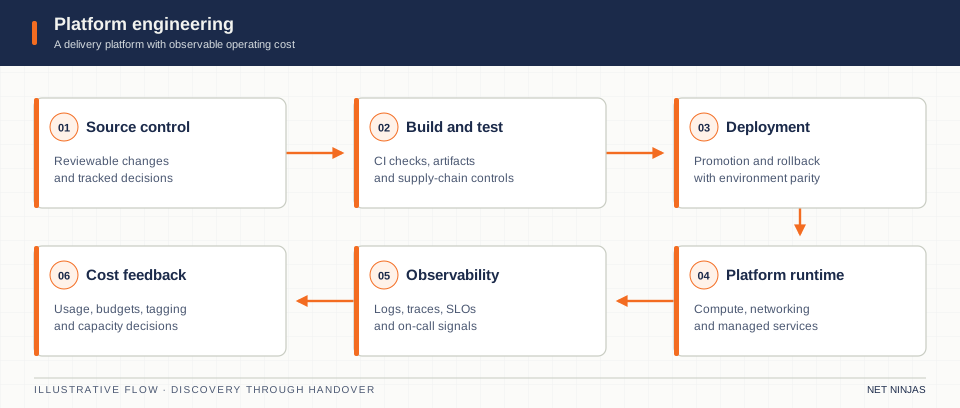
Reference architecture
How the pieces connect
An illustrative flow, not a diagram of a client environment.
1
Source control
Reviewable changes and tracked decisions.
2
Build and test
CI checks, artifacts, and supply-chain controls.
3
Deployment
Promotion and rollback with environment parity.
4
Platform runtime
Compute, networking, and managed services.
5
Observability
Logs, traces, SLOs, and on-call signals.
6
Cost feedback
Usage, budgets, tagging, and capacity decisions.
What's included
Infrastructure-as-Code and CI/CD pipelines
I use Terraform or CloudFormation for the platform and GitHub Actions or GitLab for delivery. A change becomes a pull request, and a rollback becomes a revert.
GitOps delivery on Kubernetes: EKS, ArgoCD, GitHub Actions
I set up EKS clusters with ArgoCD syncing from git. What runs in the cluster is exactly what's in the repository. Nothing else slips in.
Kubernetes and serverless right-sizing
I tune requests, limits, and autoscaling to real traffic. Where a cluster is more than your team needs, Lambda or Fargate takes its place.
Monitoring, logging, and alerting a small team can live with
I set up Prometheus, CloudWatch, Datadog, or New Relic for metrics and ELK for logs. Then I tune the alerts until each one means something. On-call stays bearable for a rotation of three.
Disaster recovery and data protection, automated and tested
I write replication, versioning, and access hardening as code. Then we run the recovery for real, so nobody has to hope it works. That run also produces the evidence an enterprise security questionnaire asks for.
Cost reviews that stretch the runway
I go through the bill line by line and rank every change by savings and effort. That includes the credits and committed-use discounts nobody has claimed yet. Then I carry out the changes with your team.
Where I've done it
Every item here comes from my CV. View CV.
Senior Cloud Engineer, AWS consulting partner, 2021 to 2026
Designed and integrated DevOps pipelines across customers: CI/CD on GitHub Actions, GitLab, and ArgoCD; infrastructure in Terraform and CloudFormation; monitoring with Prometheus, CloudWatch, Datadog, and New Relic; logging and alerting on the ELK stack.
Senior Cloud Engineer, AWS consulting partner, 2021 to 2026
Cut deployment time from four months to one by containerising a mobile education-management platform and building its CI/CD pipelines.
Senior Cloud Engineer, AWS consulting partner, 2021 to 2026
Hardened disaster recovery and data security for a Fortune 500 client by automating replication, versioning, and access controls across 400+ S3 buckets in Python.
Senior DevOps Engineer, engineering agency, 2019 to 2020
Co-built a Fortune 100 HR web product on Kubernetes that remains in production.
Earlier roles, 2016 to 2020
Deployed 200+ microservices on Terraform-built EKS, and led a 10-member team managing 2,000+ production instances with 100% SLA compliance.
Tools I reach for
Terraform, CloudFormation, Docker, Kubernetes (EKS), ArgoCD, GitHub Actions, GitLab CI, Jenkins, CircleCI, Prometheus, CloudWatch, Datadog, New Relic, ELK stack, Python, Bash.
Guides on this
NIS2 for startups and scale-ups
What the NIS2 directive asks of a startup's cloud platform, how to tell whether a company is in scope or a supplier to one that is, and what to fix first.
Setting up an AI-assisted development workflow
My AI engineering workflow for a team: how I set up Claude Code, Codex, and similar agents with instruction files, retrieval, shared memory, and code review.
Other services
Cloud migration
I move teams onto AWS, Azure, or Google Cloud, or out of a setup they've outgrown. I map every dependency before anything moves.
Read moreCloud security hardening
I find the gaps in your cloud accounts, identity, network, and data, rank them by what an attacker reaches first, and close them with your team.
Read moreAI-built app security review
I review the app your AI coding agent wrote, from secrets and sign-in to the cloud account behind it, and rank what to fix first. From €500.
Read moreAI integration
I do AI consulting and AI engineering for EU teams. I put language models to work on the problems that matter, and I ship them to production.
Read moreFractional cloud leadership
Cloud architecture and a senior cloud lead on a fixed monthly retainer, long before a full-time cloud team makes sense.
Read moreCommon questions
- What does a cloud cost review look at?
- Every line of the bill. I rank idle and oversized resources, Kubernetes requests and limits, storage classes, and unclaimed credits and committed-use discounts by savings and effort. Then I carry out the changes with your team. A spreadsheet on its own doesn't lower a bill.
- Do you work with Kubernetes or serverless?
- Both. I run EKS with ArgoCD and GitHub Actions where a cluster earns its keep, and Lambda or Fargate where it doesn't. Two variables decide it: the size of the team and the shape of the workload. A team of four with spiky traffic sits in a different place from a team of twenty with steady load. So the honest answer is: it depends.
- Which monitoring tools do you set up?
- Prometheus, CloudWatch, Datadog, or New Relic for metrics, and the ELK stack for logs. I tune them until every alert means something. The goal is an on-call rotation three people can live with.
- Can you prepare disaster recovery for an enterprise security questionnaire?
- Yes. I write replication, versioning, and access controls as code. We run a real recovery, and I collect the evidence an enterprise customer's questionnaire asks for.
Let's talk.
A 30-minute call, no pitch. We look at your current setup, your stage, and the thing that's bothering you about it. I give a straight opinion on what to change, what to leave alone, and whether the problem is the one it looks like. What's the one thing in your stack you'd fix tomorrow?
Prefer email or phone? hello@netninjas.eu or +31 6 45984313